Market concentration rises in humanoid robot six-axis force sensors, with top players holding more than 70% of the market
According to the latest “2025 China Humanoid Robot Six-Axis Force Sensor Market Analysis Report” released by the China GGII, the rapid industrialization of humanoid robots is driving explosive growth for six-axis force sensors, which are critical components for achieving real-time, high-precision force control.
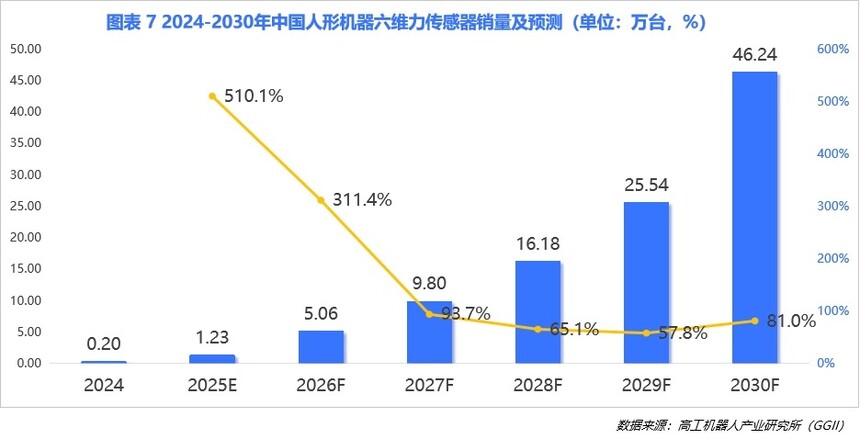
The report predicts that in 2025, China’s shipment of humanoid robot six-axis force sensors will reach 12,300 units, representing a year-on-year surge of 510.1%. As the market becomes increasingly concentrated, the top-tier companies already account for 72.6% of the market share. Looking to the medium and long term, growth momentum in this sector remains strong: by 2030, shipments are expected to increase by roughly 40 times, exceeding 460,000 units, and under optimistic projections, with accelerated adoption in consumer-facing (2C) scenarios, the market could reach a multi-billion RMB scale by 2035.
Six-axis force sensors are often regarded as the “pinnacle” of force-sensing technology, capable of measuring all possible movements of an object in space, including translations and rotations. They have become essential for real-time, precise force control in humanoid robots. Unlike traditional industrial robots that perform repetitive, pre-programmed tasks, humanoid robots achieve greater versatility through “perception-decision-action” loops, relying on force sensing when visual perception alone is insufficient for precise operations. Real-time force perception and control are therefore critical for safe interactions with the physical world.
Currently, six-axis force sensors are primarily installed in the wrists and ankles of humanoid robots, enabling dexterous hands to perform fine manipulations and supporting stable locomotion on uneven terrain. In the future, sensors may also be integrated into fingertips to further enhance dexterity.
The report highlights that Chinese domestic companies are emerging as market leaders due to their high cost-performance ratio, customization capabilities, and rapid service response, attracting a growing number of industry participants.
The capital market is also optimistic about this sector: to date, there have been eight financing events in China’s six-axis force sensor industry. By overcoming technical bottlenecks, achieving localized performance breakthroughs, enhancing delivery efficiency, and reducing application costs, Chinese manufacturers of six-axis force sensors are steadily advancing in this multi-billion RMB market, leveraging technological innovation and rapid iteration capabilities.
Recommend
-

-

QQ Zone
-

Sina Weibo
-

Renren.com
-

Douban